Most fantasy novels introduce magic as something rediscovered. The Arcanna approaches the idea differently. It presents magic as a foundational force of reality, one that shaped civilization from its earliest awakening and later withdrew from public memory by necessity rather than extinction.
The novel begins before recorded history, in an era when primordial spirits were the only conscious beings. These spirits were formed from three fundamental forces known as Soul Ether, Life Ether, and Nature Ether. Consciousness originally belonged to them alone. Over time, however, they recognized that early humanity carried a faint trace of the same blue Soul Ether that defined their own awareness. This discovery marked the First Awakening and forever altered the trajectory of the human species.
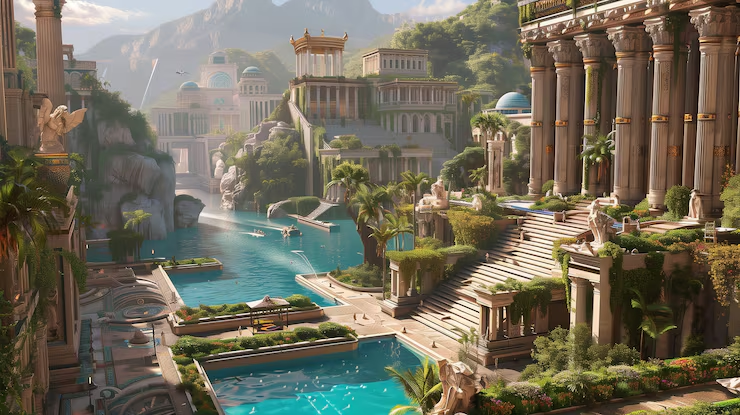
From that awakening rose the lost continent of Mu, the first great magical civilization. Mu was not built on superstition but on structure. Its cities were constructed around ley lines, immense currents of ether that flowed through vast etherium crystals beneath the earth. Magic was treated as a system governed by principles and limitations. Shamans maintained cooperative relationships with spirits. Elementalists mastered the internal manipulation of fire, water, air, and earth. Druids developed engineered tools and spires that could store and direct ether with precision.
As innovation accelerated, philosophical divisions widened. The Druids, in particular, pursued experimentation within sealed etherium chambers known as Etheneums. Their research into harmonizing Life Ether with the human soul produced catastrophic failures, including the creation of husks, entities born from corrupted energy and devoid of identity. Yet their ambition did not subside. One Druid succeeded in stabilizing red and blue ether within himself, becoming the first Warlock and demonstrating that transcendence was possible, though dangerously unstable.
The consequences of these advancements reshaped entire eras. The Great Spirit War fractured alliances between spirits and humans. The Endless War intensified ideological conflict among magical traditions. The Norse gods were revealed as mages who had mastered interdimensional magic, culminating in the rise and fall of Asgard during Ragnarok. Eventually, entire magical nations withdrew from public knowledge in what became known as the Dark Age, choosing secrecy over further devastation.
Magic did not disappear. It reorganized. Hidden cities formed in spatial folds. Arcane magic and Sorcery evolved into more structured disciplines.
What distinguishes The Arcanna is its treatment of magic as both power and responsibility. It presents a layered cosmology in which every discovery carries consequence, and every imbalance reverberates across generations. Rather than centering on a single hero, the book functions as the mythic framework beneath all future events, explaining how civilizations rise, fracture, conceal themselves, and endure.
History, in this telling, has not been lost. It has been deliberately obscured.
And what has been hidden for ages may not remain hidden forever.